GPT-6.1 Sol vs Claude Opus 5.5: what to test for production agents

In 60 seconds: GPT-6.1 Sol’s standard token price is half of Claude Opus 5.5’s across the four comparable published lines: input, cache reads, cache writes, and output. Their windows are close: 1.05 million tokens for Sol and 1 million for Opus, with a 128,000-token maximum output for both. Those facts do not tell you which model completes your workflow better. Pick two or three real tasks, run them with identical tools and controls, then compare accepted results, corrections, latency, usage, and failures. We checked the official sources on September 30, 2026.
OpenAI released GPT-6.1 Sol on September 29 for complex coding and professional work at a lower cost than Astra. Anthropic had introduced Claude Opus 5.5 on September 22 for agentic coding, knowledge work, and long-running tasks. The launches are close together, but each model occupies a different place in its vendor’s catalog. A useful comparison starts with the work your agent has to finish.
For context on the preceding tiers, see our guides to GPT-6 Astra for business and Claude Opus 5. This article stays with Sol 6.1 and Opus 5.5.
Published specifications
| Field | GPT-6.1 Sol | Claude Opus 5.5 |
|---|---|---|
| API ID | gpt-6.1-sol | claude-opus-5-5 |
| Vendor positioning | Complex coding, computer use, and professional work with near-Astra performance at lower cost | Long-running agentic coding and knowledge work |
| Modalities | Text input and output; image input; audio and video not supported | Text and image input; text output |
| Context window | 1,050,000 tokens | 1,000,000 tokens |
| Maximum output | 128,000 tokens | 128,000 tokens |
| Tool use | Yes. Responses API for tool calling; published support for function calling, web/file search, shell, computer use, and MCP | Yes. Tool use and computer use; the toolset and block shape change from Opus 5 |
| Standard price per 1M tokens | $2 input; $0.10 cache read; $2.50 cache write; $10 output | $4 input; $0.20 cache read; $5 five-minute cache write; $20 output |
| Published availability | OpenAI API; US and EU data residency, with mode restrictions | Claude API, Amazon Bedrock, Google Cloud, Microsoft Foundry, Claude Platform on AWS; Claude apps on Pro, Max, Team, and Enterprise plans |
| Migration watchpoint | Does not accept none or minimal reasoning; tool calling requires the Responses API | Thinking cannot be disabled; forced tool use errors; thinking blocks and computer use change on some platforms |
Table sources: GPT-6.1 Sol model page, OpenAI changelog, Claude Opus 5.5 model page, Anthropic announcement, and Opus 5.5 migration guide. Checked September 30, 2026. Treat any modality, region, or integration absent from those pages as not published / verify.
Sol leads on list price; cost per accepted result still needs a test
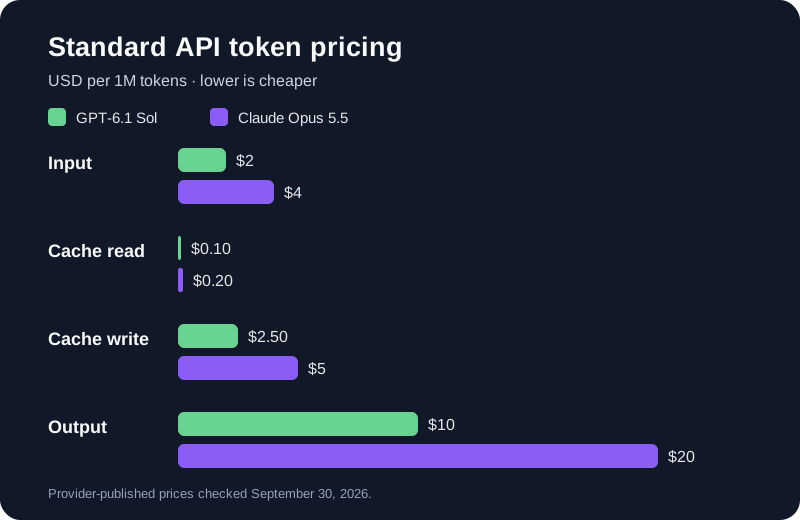
At list price, Opus costs exactly twice as much across all four lines. That does not prove every task will cost twice as much. An agent may use a different number of tokens, retry tools, fail, or finish at a different quality level. Measure cost per accepted result, keeping input, cache, output, tool calls, and retries separate.
Use the same base prompt and step limit. If a cheap draft takes half an hour to repair, token price hid the dominant cost. When both models pass the evaluation, the rate difference becomes a strong signal.
The context windows are close, and maximum output is equal
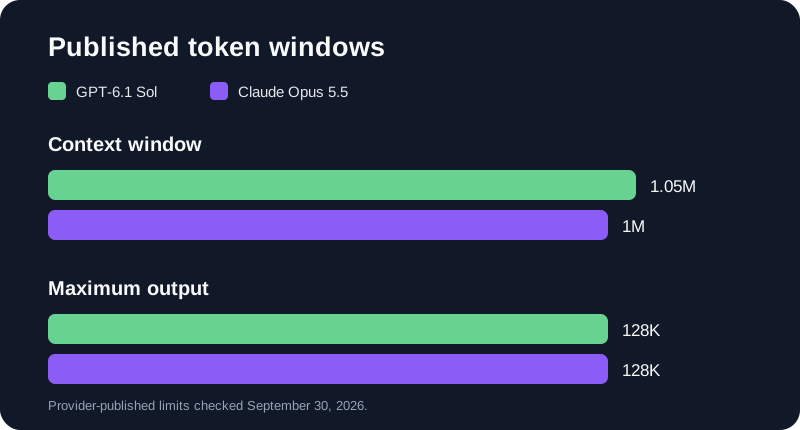
The 50,000-token context difference should rarely decide on its own. A stable agent does not pour an entire repository, CRM, or inbox into every turn. It retrieves what matters, keeps traces, and summarizes when needed. OpenAI also publishes a price change for Sol prompts beyond 272,000 tokens, so maximum capacity and marginal cost are separate questions.
How to decide without naming a universal winner
1. Quality on your task
There is no official benchmark that compares GPT-6.1 Sol with Claude Opus 5.5 under the same harness, settings, effort, and safeguards. That is why this article has no “quality” chart. Filling the gap with an estimate would add decoration, not evidence.
Build 20 to 50 representative cases: ordinary work, ambiguous instructions, missing data, tool failures, and prohibited actions. A reviewer who does not know which model produced an output can record acceptance, corrections, and failure cause. Keep the prompt version, tools, effort, and limits with every run.
2. Cost and latency
Compare the total cost of each accepted run. Record input, cache, and output tokens, external calls, steps, retries, and review time. For latency, do not copy a marketing promise across processing modes. Measure p50 and p95 in the region and tier you expect to operate.
3. Availability and integration
Sol may fit better when the agent already uses the Responses API, OpenAI-hosted tools, or the published US and EU data residency options. Opus may fit when your contract and observability already sit in the Claude API, Bedrock, Google Cloud, Microsoft Foundry, or Claude Platform on AWS. Confirm the exact model, region, toolset, and processing-mode combination before designing the rollout.
4. Breaking changes
A model ID swap can break an agent even when the prompt still compiles. For Sol, review reasoning settings and move tool calling to the Responses API. For an Opus 5 to 5.5 move, review thinking, forced tool choice, block continuity, and the new computer-use declaration. Run contract tests against streaming and every tool before comparing quality.
5. Safeguards and operating controls
Anthropic documents safeguards for cybersecurity, biology, anti-distillation, and preserved-thinking changes. Sol’s technical pages document limits and tools, but they do not turn the model into a permission boundary. Keep scoped credentials, approval for irreversible actions, logs, run budgets, and a stop switch with either model. Your application should decide what an agent may do.
A short pilot that produces a decision
Choose a workflow with a reviewable result, such as resolving a bounded issue or preparing a cited analysis. Freeze the case set and run both models with identical tools, data, and permissions. Save five measures for each case: acceptance, correction minutes, latency, full cost, and failure cause.
Then split the results by task type. Sol may win routine work on cost while Opus earns its rate on a hard subset, or the reverse may happen. The operational difference might also be smaller than the noise in your data. Routing can be a better decision than committing to one model.
Repeat the evaluation before changing snapshots, reasoning, toolsets, or safeguards. The numbers in this article describe official pages checked on September 30, 2026. Your test describes the system you will actually operate.
Official sources
- OpenAI API changelog: GPT-6.1 Sol release date, ID, positioning, and price.
- GPT-6.1 Sol model page: context, output, modalities, tools, pricing, and availability.
- Using GPT-6: GPT-6 family selection and migration notes.
- Introducing Claude Opus 5.5: launch, pricing, availability, and safeguards described by Anthropic.
- Claude Opus 5.5 model page: context, output, positioning, and breaking changes.
- Migrating to Claude Opus 5.5: thinking, tool, and computer-use changes.
Frequently asked questions
Is GPT-6.1 Sol cheaper than Claude Opus 5.5?
Yes at the published standard token rates: Sol costs $2 per million input tokens and $10 per million output tokens, while Opus 5.5 costs $4 and $20. The final bill also depends on long context, caching, tools, region, processing mode, retries, and how many tokens each model needs to finish the task.
Which model is better for a coding agent?
The provider sources do not offer a direct, comparable benchmark between these two models. Test both on the same repository with the same tools, permissions, and task set; measure accepted results, corrections, latency, tokens, and tool failures.
Can we migrate by changing only the model ID?
That is risky. GPT-6.1 Sol requires the Responses API for tool calling and changes reasoning options from earlier models. Opus 5.5 introduces changes to thinking, tool choice, conversation blocks, and computer use. Review each provider's migration guide and rerun your evaluations before moving traffic.
From insight to action
Want to turn this into an agent that works for your team?
Tell us which process you want to improve. In a free call, we will identify the first workflow worth building.